
Categories
Speciality Areas
Medical Bed Standards: Safety Requirements for Adult and Child Beds

Manufacturers, suppliers, and purchasers should be aware of the two standards covering safety and essential requirements of medical beds for adults and children, and of their recent updates.
There are two key standards for medical beds, one for adults, and the other for children. Each has a new edition in 20261,2. These documents concentrate heavily on safety elements during use in different application environments, particularly concentrating on entrapment risks. In this article we cover the backgrounds and the updates to both documents.
The safety and product standards which we follow in the UK can be British (with the BS prefix), European (with the prefix EN), or International, such as ISO or IEC. ISO covers nearly all industries, focusing on management systems, processes, and products. The International Electrotechnical Commission (IEC) is a global organization that publishes international standards and conformity assessment systems for all electrical, electronic, and related technologies. The medical bed standards have input at the ISO/IEC and CEN levels and have been adopted in the UK, hence the annotations BS EN IEC1,2.
Medical beds are CE marked in Europe, and also increasingly UKCA marked in the UK. For their technical files it will be expected that the products have been tested to, and passed, recognised safety and performance standards, which is where the BS EN IEC 80601-2 series of standards come in.
History
In 1996, the IEC published the first edition of the particular standard for electrically operated hospital beds, IEC 60601-2-38. The publication was in response to the demand in the field for a universal standard addressing hazards specific to the safety of a hospital bed. Used in conjunction with a manufacturer’s risk assessment, the standard was felt to be the current thinking on establishing a basic safety benchmark for industry.
An amendment to IEC 60601-2-38 issued in 1999 recognized the need to mitigate against a risk of patient entrapment in the side rails, again combined with the use of the manufacturer’s risk assessment. (Annex AA in both current documents provides explicit illustrations of the risks – for examples see Figures 1 and 2.) Although this improved the particular standard, it still was centred upon electrically operated hospital beds, and failed to take into account manually operated hospital beds and products in other medical environments.
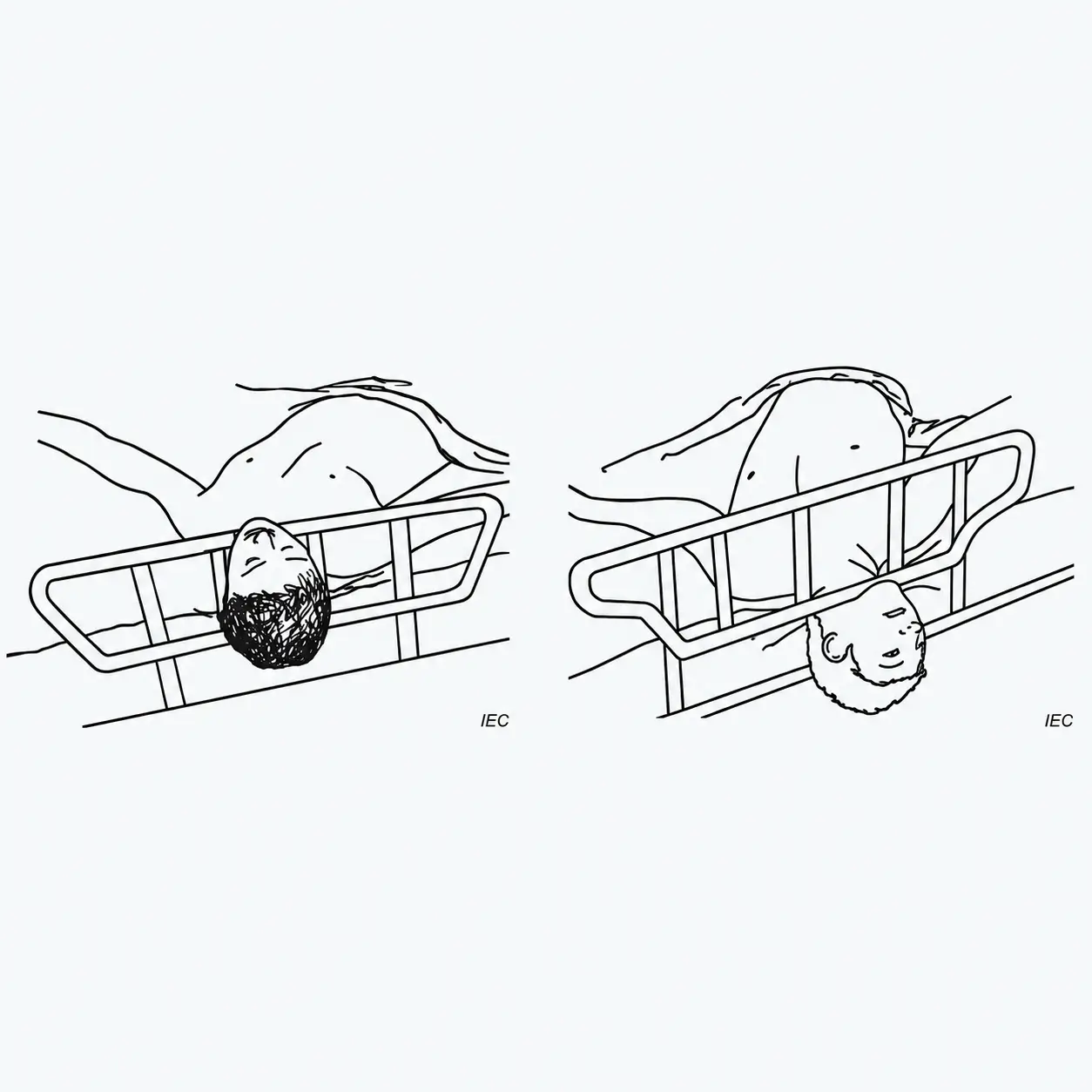
In 2000, the EN 1970 standard (Adjustable beds for disabled persons – Requirements and test methods) was published, which addressed beds used by persons with disability to alleviate or compensate for a disability or handicap. This standard offered a broadened scope in conjunction with IEC 60601-2-38, but after the edition of Amendment 1 to IEC 60601-2-38, the opportunity presented itself to combine the two standards into a common, international standard.
As work began on the integration, the IEC adjusted its stance on basic safety and essential performance, integrating them into the third edition of IEC 60601-1. It therefore became necessary to align the new bed standard with this third edition. The particular standard was given a new number, IEC 60601-2-52, and work began on alignment with IEC 60601-1.
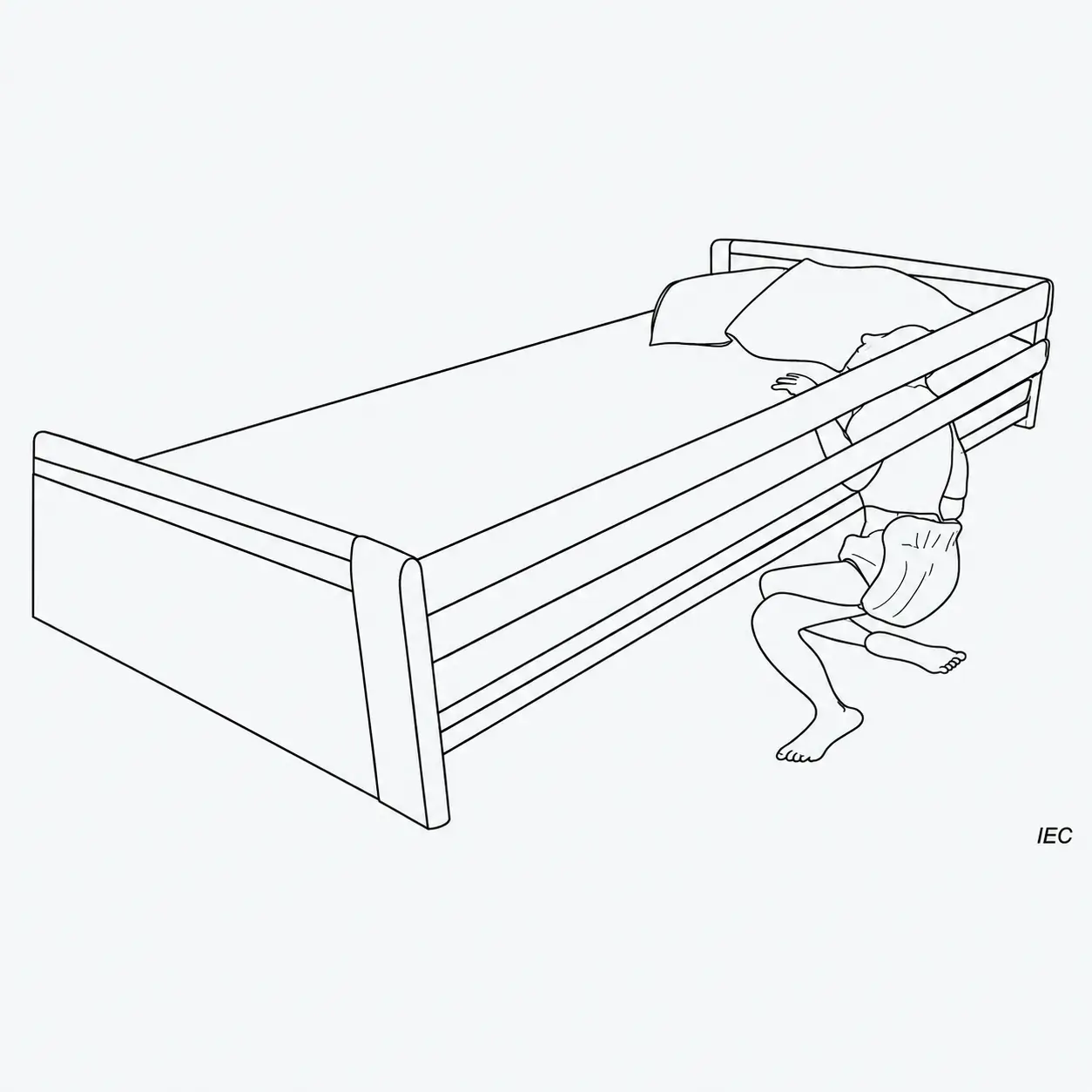
BS EN IEC 80601-2-52 was the realization of much work in alignment, and scope adjustment between IEC 60601-2-38, EN 1970, and the third edition of IEC 60601-1. It represents the current thinking pertaining to the basic safety and essential performance of the medical bed as used to improve comfort and functionality for patients. Because the standard is currently a mix of electrical and product design elements, it became a joint IEC/ISO project, and hence the numbering change from 60601 to 80601.
Child beds
IEC 80601-2-52 was not adapted to the needs of children (or adults with an atypical anatomy) in that it did not foresee a maximum distance for the bars that is small enough to prevent accidents for use with this target group. A part of the safety problem is due to the fact that medical beds for adults are not appropriately labelled as being designed only for adults within the defined anatomy parameters (see definitions below). Purchasers and users have therefore not always been aware of the risk of medical beds for young patients (nor for adults with an atypical anatomy). Therefore, clear labelling as to the targeted patient groups for medical beds complying with IEC 80601-2-52 should reduce the risk of inappropriate use of this kind of medical beds for the respective patient groups.
The need for a separate standard for exceptions to 80601-2-52 was originally covered by EN 50637 (Lisclare produced an excellent summary of the differences between adult and child bed testing3.) With the issuance of 80601-2-89, the content of EN 506373 has been replaced, and updated with around 50 amendments, bringing it in line with 80601-2-52. The authoring working group recognized that the definitions of the terms ‘adult’ and ‘child’ have been selected to be based on physical anthropometric measures (and they recognised that these can vary from one jurisdiction to another).
Thus the dimensional requirements of BS EN IEC 80601-2-89 specifies medical beds with an internal length of up to 180 cm suitable for a body length of up to 155 cm. If a manufacturer wishes to make a bed that can be used by both a child and an adult, e.g. internal length of 180 cm or more, then both BS EN IEC 80601-2-52 and BS EN IEC 80601-2-89 have to be applied.
However, on a day-to-day practical basis, if the highest level of safety is to be achieved for patients and operators, it is necessary to rely on caregivers to use their professional judgement to differentiate the needs of children from those of adults, taking into consideration not only the physical, psychological, and medical needs of the individual, but also the patient’s preference.
Terms and definitions
The bed standards have clear definitions as to the target patients and bed sizing, as follows:
- Patient: living person undergoing a medical procedure or person with disability
- Person with disability: person with one or more impairments, one or more activity limitations, one or more participation restrictions or a combination thereof
- Adult: patient having a physical size equal to or more than 146 cm, a mass equal to or more than 40 kg, and a body mass index (BMI) equal to or more than 17
- Adult with atypical anatomy: adult ranging outside the definition of Adult
- Child: patient having a physical size equal to or less than 155 cm and a mass equal to or less than 70 kg, and may display cognitive immaturity, exploratory behaviours, risk-taking tendencies, or any combination
- Medical bed: device for which the intended use is sleeping, resting, or both, that contains a mattress support platform and intended to assist in diagnosis, monitoring, prevention, treatment, alleviation of disease, or compensation for an injury or disability
- Cot: medical bed with an internal length ≥90 cm and <140 cm provided with protection panels also intended for children able to stand up in bed
- Crib: medical bed with an internal length <90 cm provided with a protection perimeter, intended for children until they are able to sit, kneel, or to pull themselves up
Application environments
Both standards recognise that medical beds may be used in different environments in which the risks to the patient are very different. For example, a maternity bed designed to aid in the birthing process is primarily used with patients below the age of 50. These patients generally do not fit into a high entrapment risk category, thus entrapment guidelines need not necessarily be considered – unless the product is designed also to be used in normal use in various other application environments, or there is reasonably foreseeable misuse.
There are six different risk-related scenarios covered:
- Intensive care or critical care provided in a hospital
- Acute care provided in a hospital or other medical facility
- Long-term care in a medical area, including nursing homes or rehabilitation and geriatric facilities
- Domestic arenas
- Outpatient care or ambulatory care
- Psychiatric care or mental health care, including prisons, jails, correctional facilities (80601-2-52 only)
Adult bed updates
Here’s a summary of some of the seventeen updates:
- The scope clarifies that medical beds for adults with an atypical anatomy are now covered within BS EN IEC 80601-2-89.
- Medical beds for psychiatric environment (application environment 6) have now been included in the standard.
- The gap between headboard and adjacent side rail shall be <60 mm or >318 mm in application 1 only. In other environments only <60 mm is allowed.
- The height of side rails of ≥20 mm shall also be fulfilled with a specialty mattress in the bed. Otherwise, a risk assessment shall be performed.
- It has been made clear that accessories shall be included in the evaluation of gaps in relation to side rails/medical bed.
- Requirement for stability in non-transport position has been reduced in accordance with IEC 60601-1.
- Lifting poles (dynamic test): the compliance criterion has been changed.
- The test method for machine washable medical beds has been changed: the test cycles are now specified to 50 for application environment 4 (homecare) and 250 for all other environments.
- Change of requirements in relation to a pendant control.
- The height of the mattress shall be 20 mm higher than any construction part (e.g. medical bed frame, side structure or the lowered side rail) at the area intended for ingress and egress. It has been specified that the measurement shall be taken from the top of an uncompressed mattress.
- Combination of medical bed and mobile hoist: the requirement for a 150 mm free space underneath the bed is now valid for all application environments.
- The foot clearance area between moving parts and the floor is still 130 mm, but alternative options are now allowed, e.g. for a low floor bed.
- Various requirements from Annex BB that are valid for all application environments have been moved into the normative part of the standard, e.g. strength and durability.
- New Annex DD Guidance and recommendations for periodic inspection has been included in the standard.
- New terms have been included in the definition clause together with the corresponding figures for ‘head down tilt’ and ‘foot down tilt’.
- New graphic symbols have been included in the marking section – for some examples see Figures 3 to 5.
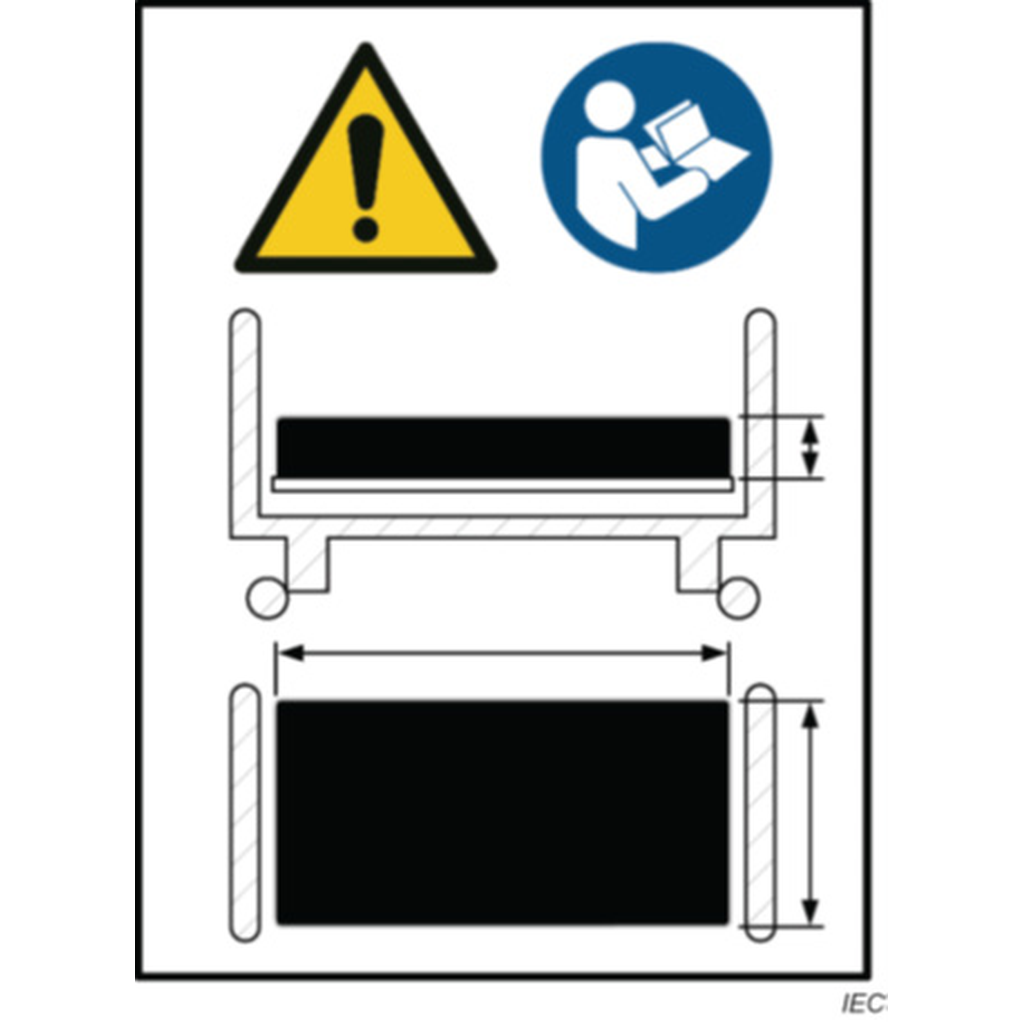
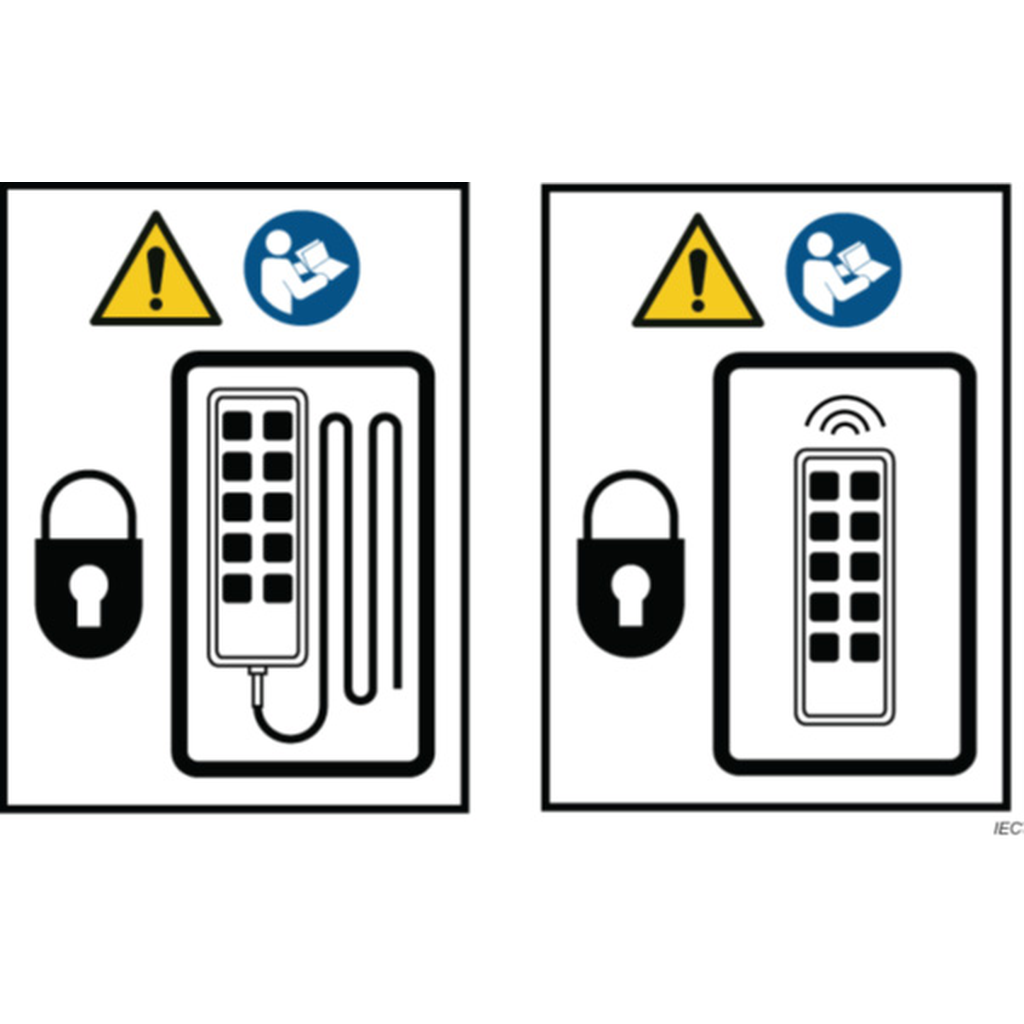

As a footnote relating to Figure 5, please remember that under the MDR, medical devices can only be washed within a medically CE marked Class I device, and disinfection with Class IIa devices or chemicals.
Child bed updates
Many of the changes have been to incorporate overarching clauses from 80601-2-52. These bring the total to around 50 changes. I’ve selected a number of the more specific child related ones here.
- Definitions of patient and child.
- Marking on the medical bed for patient length: text added: ‘If the medical bed is also intended for use with an adult, it shall be additionally marked with the allowed patient length.’
- The distance between moving parts for cribs and cots has been changed from less than 3 mm to less than 5 mm.
- Regarding trapping zones for feet and toes: new text inserted: additional mitigations shall be applied for medical beds reducing the gap below the number specified and documented in the risk management file. The instructions for use shall document the actions necessary to achieve the reduced gap and warn the user about the hazards caused by this function.
- Instability from horizontal and vertical forces: test force changed from max patient weight to 800 N.
- Movement over a threshold: the height of the threshold during the test has been reduced from 20 mm to 10 mm.
- Height of protection perimeter above uncompressed mattress for cribs: the requirement has been reduced from ≥275 mm to ≥200 mm above the compressed mattress.
- Head/foot board assembly: only for oversize cots and junior beds, the design shall allow immediate and unimpeded access to the patient from the head end in emergency situations. This still applies only in application environments 1 and 2.
- Cribs and cots choking hazards: a new requirement with a test method has been included.
- If multiple socket outlets are supplied, they shall be protected from access by a child, e.g. in a lockable box, tamper proof construction, or other means.
- New annex: Guidance and recommendations for periodic inspection.
Acknowledgement
I would like to thank Greta Randrup Olsson from the Danish Standards committee for sharing her summary of the changes in the new editions of the referenced standards as extracted in this article.
References
- BS EN IEC 80601-2-52:2025 Medical electrical equipment – Part 2-52: Particular requirements for the basic safety and essential performance of medical beds (Replaces BS EN 60601-2-52:2009 and AMD1:2015).
- BS EN IEC 80601-2-89:2026 – TC Medical electrical equipment – Particular requirements for the basic safety and essential performance of medical beds for children (Replaces EN 50637:2017).
- https://www.lisclare.com/wp-content/uploads/Junior-Bed-Childrens-Bed-Standards-June-2023.pdf


